
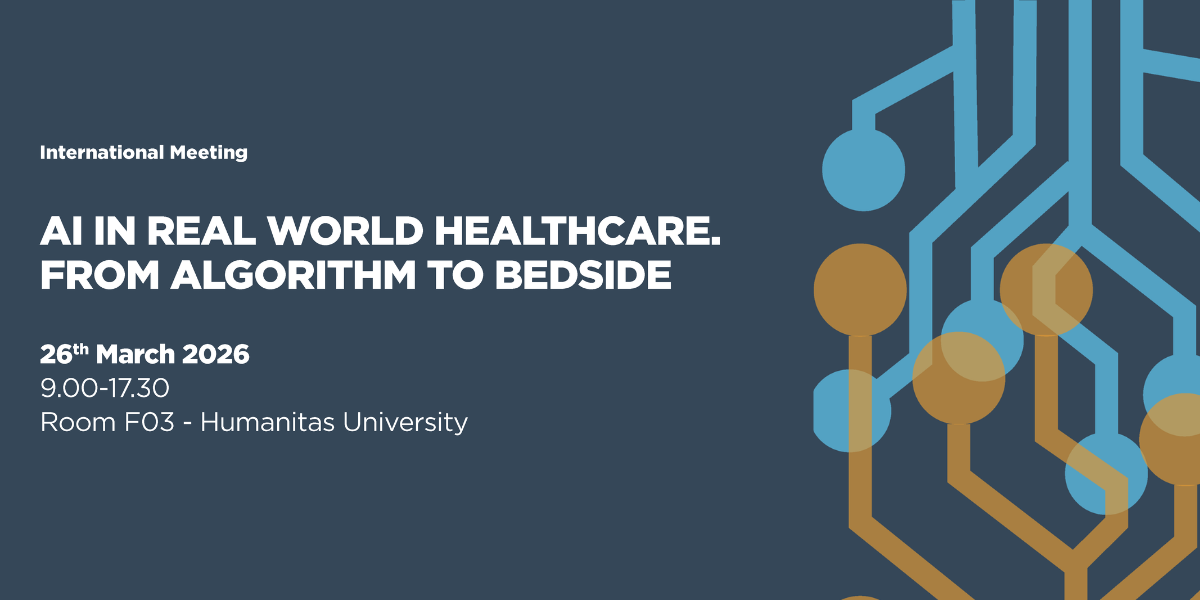
Artificial Intelligence is transforming the healthcare landscape, opening up new possibilities for diagnosis, precision medicine, and the organization of healthcare systems. With the aim of exploring these changes and fostering dialogue between research, clinical practice, and industry, Humanitas University hosted the international event “AI in Real World Healthcare – From Algorithm to Bedside” on 25th and 26th March, 2026.
The initiative was structured around two main components: the Digital Health Hackathon and the International Meeting.
The two-day event was inspired by the University’s transdisciplinary educational pathways, such as the Master’s Degree Program in Data Analytics and Artificial Intelligence in Health Sciences (DAIHS), developed in collaboration with Bocconi University. The program is designed to train professionals with a solid understanding of the healthcare sector and advanced skills in data analytics, artificial intelligence, and machine learning. Taught entirely in English, the course integrates biology and medicine with statistics, computer science, artificial intelligence, healthcare regulation, and ethics, with the ultimate goal of improving patient care and quality of life.
Hackathon: Human and Artificial Intelligence Facing the Challenge of Data
The Digital Health Hackathon was a one-day competition open to university students, PhD candidates, and medical residents. Participants, organized into multidisciplinary teams and supported by expert mentors, tackled four clinical challenges – in neuro-oncology, cardiology, gastroenterology, and anesthesiology – using anonymized datasets to identify the most relevant information and develop AI models capable of addressing specific clinical questions. The aim was to provide young talents with a hands-on experience, enabling them to better understand clinical databases and explore new AI applications in healthcare.
“The Hackathon represented a natural extension of the DAIHS program,” explains Prof. Letterio Politi, President of the Master’s Degree Program in Data Analytics and Artificial Intelligence in Health Sciences (DAIHS) at Humanitas University and Bocconi University. “After acquiring the theoretical and methodological foundations of data science, computing, and AI applied to healthcare, students had the opportunity to test their skills in a real-world challenge alongside peers from different disciplines. This experience also helped them develop essential soft skills, such as the ability to interpret clinical problems, analyze data, interact with healthcare professionals, and translate acquired knowledge into innovative solutions.”
Fourty participants, including students and medical residents aged between 21 and 29, registered for the March 25 Hackathon – 20 women and 20 men– from several institutions: Humanitas University, Bocconi University, Politecnico di Milano, and the University of Brescia.
“This event provided an important opportunity for professional and career development, as it enabled participants to clearly understand the contribution of each role involved – from clinicians to data scientists – in the development of AI models, while also gaining a broader perspective on others’ expertise,” says Massimiliano Greco, anesthesiologist and Associate Professor of Anesthesiology at Humanitas University.
“By working side by side, students learned not only to value their own role, but also to understand different languages, methods, and approaches, developing a more cross-disciplinary mindset and stronger collaboration skills,” adds Riccardo Levi, bioengineer and researcher at Humanitas University.
The International Conference
The following day, the International Meeting brought together clinicians, researchers, data scientists, and industry experts to discuss the role of AI in healthcare. Through keynote lectures and expert testimonials, the conference explored topics such as data infrastructures, real-world AI applications in healthcare, precision medicine, and new models of education and innovation aimed at transforming patient care.
The guest of honor was Prof. Richard Barker, Founding Director of the Centre for the Advancement of Sustainable Medical Innovation (CASMI) at the University of Oxford, who delivered a keynote address on The past, the present and the future of medicine.
During the meeting, the winners of the Digital Health Hackathon were also announced, celebrating the most promising ideas developed during the competition.